
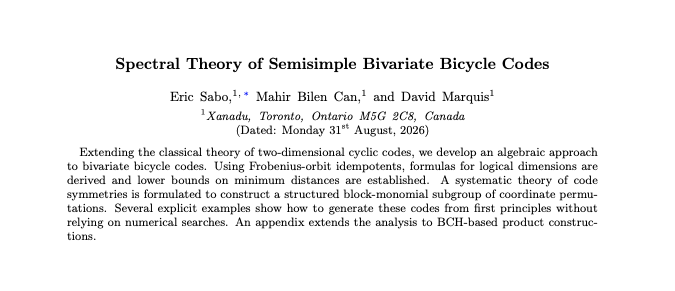
Finding high-performing bivariate bicycle codes has historically meant running exhaustive computer searches, testing candidates one at a time. Researchers at Xanadu have developed an algebraic framework that breaks these codes down into simpler finite-field components—turning naive computational searches into a systematically navigable design space. With this framework, researchers can now: - Analyze key properties like encoded qubit counts and rigorous error-protection bounds. - Map out crucial code symmetries. - Understand why high-performing codes work and directly target where to find better ones. Read the full preprint on arXiv: 📷 ↧ Spectral Theory of Semisimple Bivariate Bicycle Codes Extending the classical theory of two-dimensional cyclic codes, we develop an algebraic approach to bivariate bicycle codes. Using Frobenius-orbit idempotents, formulas for logical dimensions are derived and lower bounds on minimum distances are established. A systematic theory of code symmetries is formulated to construct a structured block-mon...
published
Finding high-performing bivariate bicycle codes has historically meant running exhaustive…

Latest documented BWB result
BWB member result
Took $1.20 profit on the remaining Puts on the Strangle - holding the Calls now
Historical results are not a promise of future performance. Trading involves substantial risk.This public post is a timestamped information archive, not personalized financial advice. Alerts can change as markets move. Join Billy's private group for the complete daily stream and follow-through.