
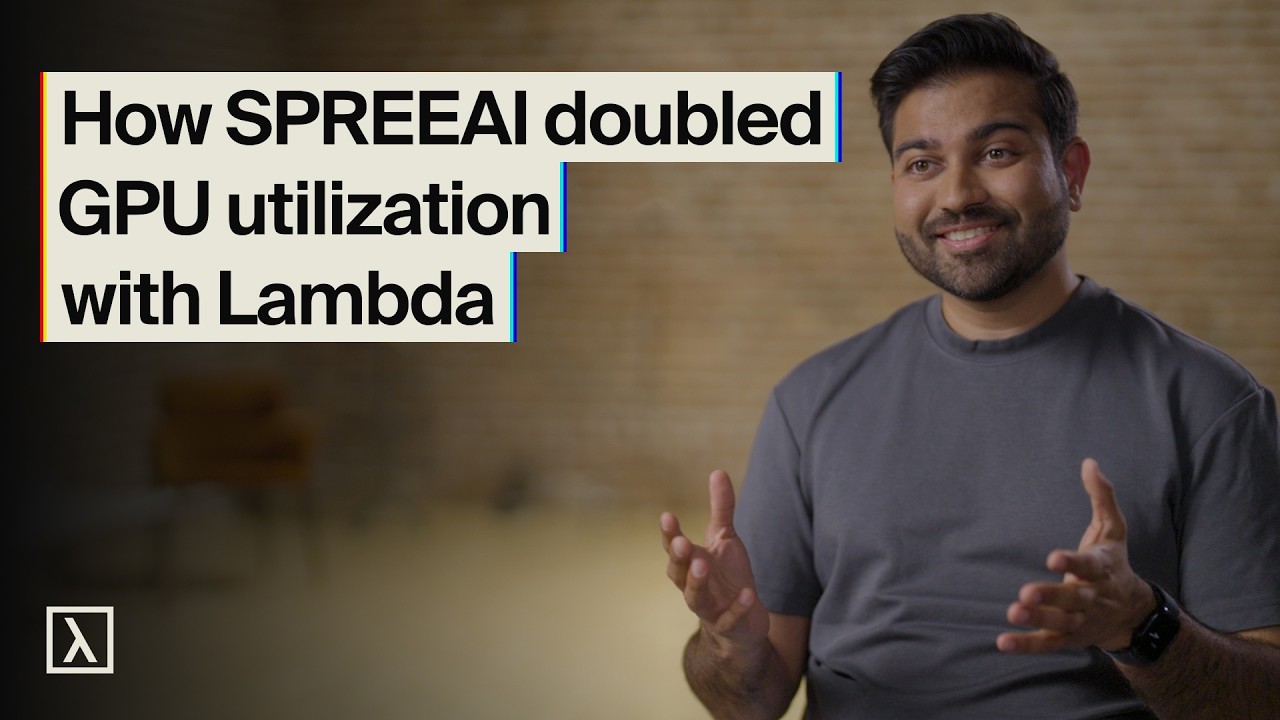
Online shopping has a $45B fitting-room problem, and @SpreeAI is building photorealistic virtual try-on to solve it. SPREEAI is building virtual photorealistic try-on for online shopping to help users find the clothes that fit best. To deliver this, SPREEAI’s unified diffusion model has to handle human pose transfer, cloth deformation physics, identity preservation, and spatial texture fidelity in a single pass. Training on high-quality images across multiple dimensions creates data-heavy training cycles, causing storage requirements and costs to grow rapidly. At that scale, gradient synchronization across nodes becomes part of the training-time equation. Every slowdown in gradient exchange extends the run. That is why memory capacity and network performance matter as much as raw GPU compute for this workload. Lambda’s InfiniBand-connected clusters give SPREEAI the high-bandwidth, low-latency interconnect needed to keep distributed diffusion training moving instead of waiting on communication. Paired with Lambda’s ML engineering expertise, this doubled MFU, while zero egress costs reduced SPREEAI’s storage costs by 30×. Hear from SPREEAI’s Head of Engineering, Mrinal Shukla, about the challenges behind building photorealistic virtual try-on—and how the team solved them with Lambda. ↧ How SPREEAI doubled GPU utilization with Lambda SPREEAI trains the diffusion model behind photorealistic virtual tr...
published
Online shopping has a $45B fitting-room problem, and @SpreeAI is building photorealistic virtual try-on to solve it. SPREEAI is building virtual photorealistic try-on for online shopping to help users find the clothes that fit best. To deliver this, SPREEAI’s
Open the original public source →
Latest documented BWB result
$META market result
I sold the $META $655 Puts 9/25 for $7.60
Historical results are not a promise of future performance. Trading involves substantial risk.This public post is a timestamped information archive, not personalized financial advice. Alerts can change as markets move. Join Billy's private group for the complete daily stream and follow-through.