
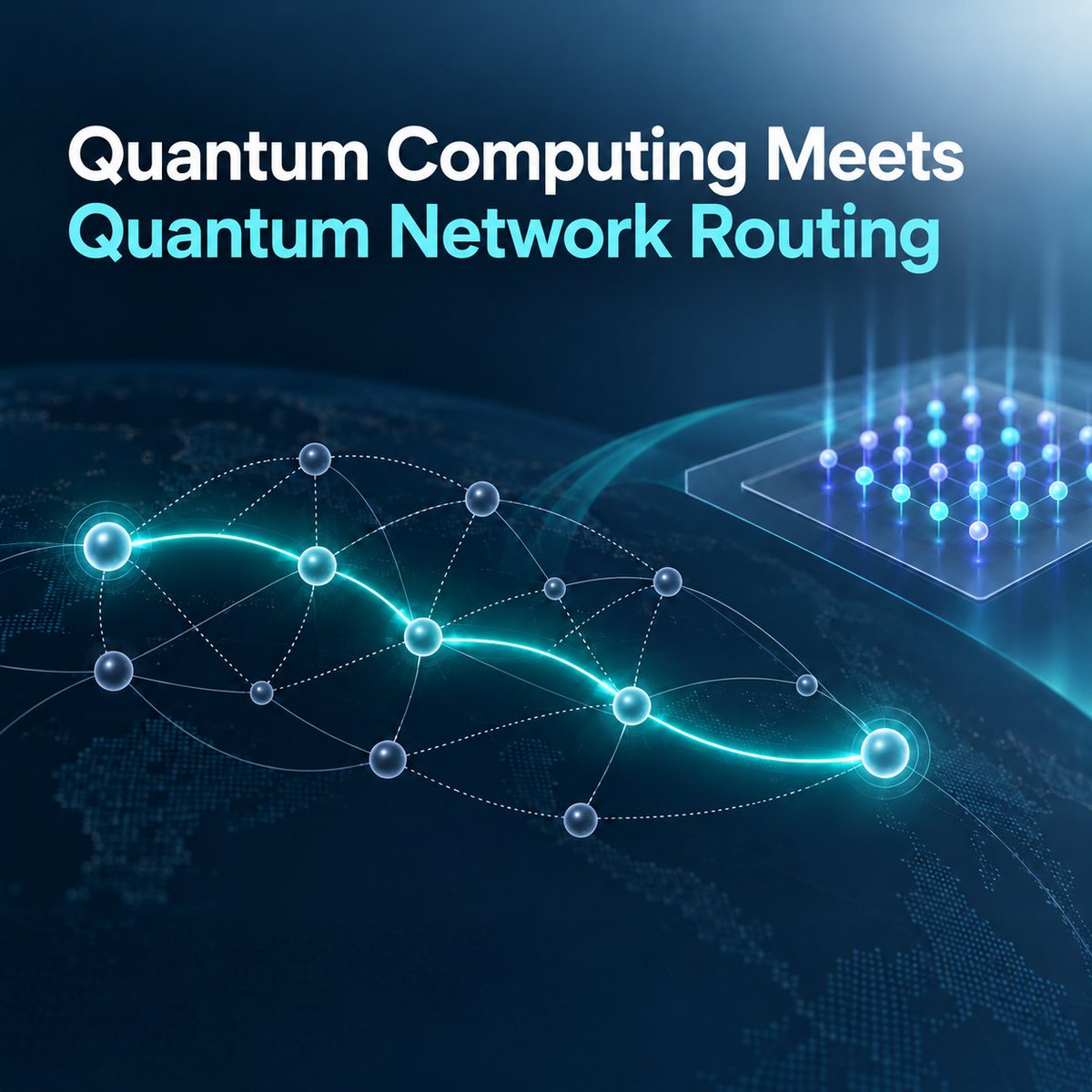
It’s always exciting to see foundational research take on a life of its own. Researchers at Pasqal published a new paper exploring how neutral-atom quantum computing might be used to optimize entanglement routing in quantum networks. Their work builds directly on research coauthored by Aliro Co-Founder and CTO Michael Cubeddu with collaborators at NIST, which examined entanglement routing as a core networking challenge and is cited as reference #1 in the new paper. () Why does routing matter? As quantum networks grow, distributing entanglement efficiently will require making routing decisions under constraints including limited network resources and end-to-end fidelity. These are difficult optimization problems, and an important part of turning interconnected quantum hardware into large-scale networks. The Pasqal team takes an interesting approach: a hybrid classical-quantum framework in which classical optimization selects routes while a neutral-atom quantum optimization method helps generate fidelity-feasible candidate paths. The authors describe the work as a proof of concept rather than evidence of quantum utility or scalability, but that's exactly what makes developments like this worth watching: researchers are connecting advances in quantum computing with the practical problems involved in operating quantum networks. We’re looking forward to seeing where the work goes next. Check out the paper here: 📷 ↧ ↧ A Neutral Atom-Based Hybrid Classical-Quantum Approach for the Enta... Efficient end-to-end entanglement distribution in quantum information networks requires routing under limited resources and fidelity constraints. We study entanglement routing as a fidelity-constrained unsplittable multicommodity flow problem that maximizes the number of admitted requests. As
published
It’s always exciting to see foundational research take on a life of its own. Researchers at Pasqal published a new paper exploring how neutral-atom quantum computing might be used to optimize entanglement routing in quantum networks. Their work builds directly

Open the original public source →
Latest documented BWB result
$AAPL market result
I sold the $AAPL $320 Puts for 11/20 - $5.30
Historical results are not a promise of future performance. Trading involves substantial risk.This public post is a timestamped information archive, not personalized financial advice. Alerts can change as markets move. Join Billy's private group for the complete daily stream and follow-through.